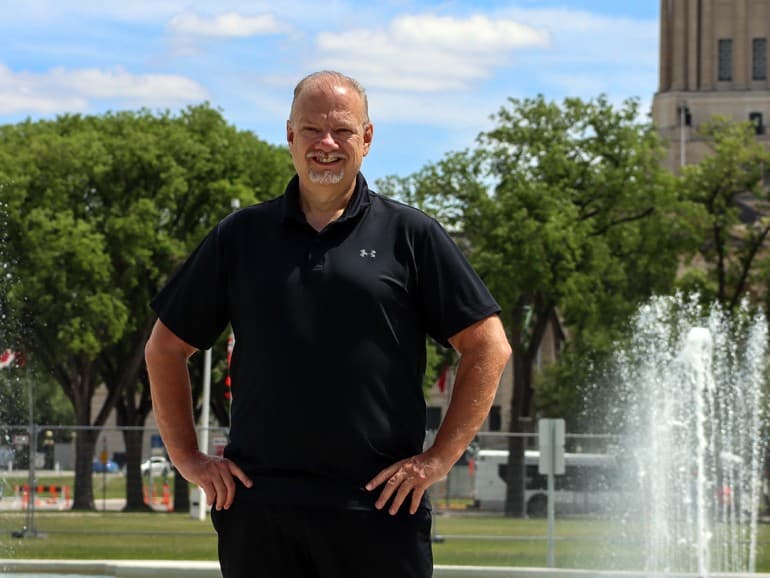
The MLA for Steinbach is calling the spring sitting of the Manitoba Legislative Assembly a missed opportunity. MLAs wrapped up the spring sitting on Monday, and Kelvin Goertzen says the NDP Government chose to ignore the pleas of Manitobans.
The Progressive Conservatives proposed raising Manitoba's basic personal income tax exemption to $30,000, which Goertzen says would have provided families with an additional approximately $3,000 each year. Instead, Premier Wab Kinew and his government opted to stick with their plan to remove the Provincial Sales Tax from groceries starting July 1st.
"Ninety-five per cent of groceries already don't have PST applied to them," says Goertzen.
Goertzen says removing the PST from chips and other junk food will not make a real difference for most Manitobans.
Related Stories:
- Tax relief proposal and busy legislature highlight spring session, says MLA
- Manitoba to remove PST from all grocery food items, premier says
- Conservatives use marathon sitting to push for tax relief
Goertzen defends marathon sitting
In an effort to try and push for greater tax relief for families, the Conservatives initiated a marathon sitting last week at the Legislature. In the end, the NDP chose to stick with their plan to eliminate the PST on groceries rather than raise the basic personal exemption.
Goertzen says the marathon sitting was still worth it. He notes that when you have a majority government in the system of democracy that we have, the powers of the opposition are somewhat limited. Goertzen explains that what the opposition can do is slow things down by putting up roadblocks. He notes that what this ultimately achieves is that it gives government the opportunity to change its mind, and it also raises awareness. Goertzen says in this particular case, the marathon sitting provided an opportunity for the NDP to have a change of heart, while also explaining to Manitobans what is happening with their money.
"I do think it raised a lot of awareness about what is happening in the budget," says Goertzen. "That a few cents off of some of the snacks and chips that people buy isn't going to make a difference in their lives."
He adds that if the public knows what is happening inside the Legislature, it may put more pressure on the government to respond.
"Ultimately, there is going to be an election as well, and people have to be able to make a choice," says Goertzen. "And this is something they can look at and go, 'okay, how did the government respond when I needed help the most?'"
Goertzen says social media ban an 'important discussion'
Goertzen says another issue that highlighted the spring sitting had to do with our provincial government's plans to ban social media and AI chatbots for youth under the age of 16.
"I think it's an important discussion," says Goertzen.
But he says there needs to be more details in the plan, including how it can be enforced. Goertzen says ideally, these sorts of decisions are left to families and parents. However, he acknowledges that children can go many hours at a time without being under the influence of their parents.
Goertzen says there is a huge crisis around the world involving the mental health of young people. He notes we are seeing increasingly high levels of anxiety and other mental health challenges, and some of this can be blamed on social media.
"I'm really interested to see what the proposals are," he adds.
Goertzen says he expects there to be consultations on this topic, and he encourages Manitobans to be engaged in that process.
"I want to encourage Manitobans to be engaged in that discussion and to provide their feedback when the opportunity comes," he says. "Because it is going to be something that I think is significant for the future of young people in our province."
Related Stories:
- Province exploring social media ban for youth amid mental health, data concerns
- Manitoba Premier explains the reason behind time change survey
Goertzen says it is time to do away with time change
Another topic this spring sitting had to do with time change. Premier Kinew announced that a survey has been made available through engageMB, where Manitobans can have their say on whether to continue with the tradition in Manitoba, and whether to stick with Daylight Saving Time (DST) or Standard Time (ST).
Goertzen says when it comes to turning our clocks twice a year, he thinks Manitobans are generally quite annoyed by this practice. And, he says he always thought Manitoba would only choose to end the tradition if and when the Americans do. However, Goertzen says it may end up being our neighbours to the west that spark the change here. Saskatchewan and Yukon no longer change the time, and Alberta, Northwest Territories, and B.C. are in the process of stopping the time change.
"I believe that sometime within the next year a decision will be made," suggests Goertzen.
He says the bigger debate right now is probably whether to ultimately stay on DST or ST.
"I won't mourn the end of changing the clocks; I think I, like many people, have been irritated by it," he says. "I'm glad that there are jurisdictions close by that are doing that as well. Because had we sort of done it alone, that would have caused all sorts of other challenges and issues."
Goertzen looks forward to summer in the constituency
With the Legislature now adjourned until September, Goertzen says he will be spending more time in the constituency. Goertzen says that as much as he enjoys the Legislature and the democratic process, it has become more toxic in recent years.
"We saw it this session again," he says. "Where people were shouting and saying some really hurtful things to each other."
Goertzen says he is happy to leave that part of the job for the next few months. Having said that, Goertzen notes he will still be going into the Legislature over the summer months for various committee meetings. However, the summer months are also a time for getting out into the constituency. He notes that hearing the day-to-day concerns of residents helps put things into perspective. Goertzen explains that often a particular item can be debated for days, weeks or months in the Legislature, when in reality the rest of the province is not talking about it.
"You quickly realize that there is often a disconnect between what feels important in the Legislature and what is truly important in the community," he says. "It's good to reconnect back into the community and away from the debates of the Legislature to really get grounded and get a sense again of where people are at in terms of the important issues to them."
]]>